Short Stories and Essays
- The Traditional Family, An Endangered Species
- My First Encounter With a Living Prophet
- John the Baptist, Our Elias-Assignment, and the Word of Wisdom
- A Strange Twist
- Rejoicing in the Accomplishments of Others
- It Takes More Than One Breath for This Jump
- Our Unplanned Trek from Bald Knob to Firetower Road
- A Christmas Story from World War II
- My Clemson Basketball Experience (Freshman Year 1965-1966)
- A Short Essay About Chiasmus
CLICK FOR NEXT INDEX PAGE
MY BACKHOE ROLLOVER STORY
by
John E. Enslen
(Copyrighted September 18, 2021)
Not everyone survives to write a firsthand account of a backhoe rollover accident. I want to tell you about mine while I am still recovering from some injuries.
The date was September 13, 2021, a Monday. I had an unusually good prayer that early morning. After thanking my Heavenly Father for lots of blessings, I did not ask for anything specific. I told Him that he had infinitely more knowledge on exactly what I would need that day, and that I would like for Him to bless me with those things He knew I would need. I would later distinctly remember that prayer and its importance, I believe, in saving my life.
The weather was gorgeous and near perfect for outside work. Our construction project may not have equated moving a mountain, but it was certainly moving at least a large hill. We were taking dirt from one hill in the nearby woods and moving it into a depressed area in front of our new two-story Overlook Lodge. With the aid of one frontend loader/backhoe and one large dump truck, we were incrementally, load upon load, here a little and there a little, transforming a deep gulley into a hill. We were several days into the project and had made good progress. There were three of us working on the project this particular day: David, Ray, and myself.
David and Ray were the professionals. David operated the frontend loader/backhoe and Ray drove the long dump truck. I only cleared the dig site of trees with my chainsaw and stayed out of the way. But on that day I decided to be more helpful by adding my old frontend loader/backhoe to the dirt-moving operation.
I am already tired of writing the compound term “frontend loader/backhoe,” although that is the most accurate way to describe a type of earth moving equipment that has a dual purpose. It is really two machines in one: (1) a frontend loader bucket that is located on, you guessed it, the front, that can be used to pickup, haul, dump, and move dirt, plus (2) a long jointed arm located on the rear that can be used to dig, scoop, and pile dirt, or load dirt into a dump truck or other vehicle suitable for hauling dirt. The two operations are separate and mutually exclusive. In other words, you can only do one of those two operations at a time. From henceforth I will more simply refer to the machine as a “backhoe,” the most common street terminology for the dual-purpose machine. That will save time, writing and reading, and also save some ink if anyone ever decides to print this story.
Before I tell you about my rollover accident per se, I need to tell you about my limited experience with operating heavy equipment. I was not raised on a farm. I must admit that I was more of a city boy—actually a rural small-town boy. My first home as an infant in the latter half of the 1940s was in a small rental area situated within a residence on North Bridge Street in Wetumpka, Alabama.
Prior to my outgrowing a small baby stroller, my paternal grandfather, who owned a sawmill operation as one of his enterprises, provided my parents with the rough lumber they needed to build themselves a frame house on the east side of the Montgomery Highway, later called South Main Street at that particular location. The house was built on the south side of town, next to where the Citizens Bank would later be constructed within the “Y” of an intersection. We lived there only about four years. Just before I started to grammar school, we moved a little further south to a new subdivision called Brookside Drive. It was the second residential subdivision built in Wetumpka, coming shortly after the first phase of Meadowbrook.
During my high school years, I was in the minority that chose not to go the FFA (Future Farmers of America) route, electing instead to take courses like typing and Spanish. I had no academic training in tractor driving, but being closely associated with my FFA buddies, with whom I played football and basketball, I felt it was something I could learn to do if I ever had the need because they had been able to do it from the time they were early teenagers.
As it turned out, the first time I would climb into the seat of a tractor, a small 1950-something gray Ford tractor, would be in the hot summer of 1968 when I was 21 years of age. I had volunteered to help my future father-in-law, Harold Brown, do some work on his cattle farm near Hartwell, Georgia. Making a good impression would be to my advantage whenever I asked for the hand of farmer Brown’s daughter. I know that sounds like the beginning of a “farmer Brown’s daughter” joke, but operating a tractor for the first time without experience or training was no joke. After getting the hang of an accelerator on the steering column and using a clutch for gear changing, I slowly, and with some violent jerking motions from time to time, accomplished the dusty plowing job. By the way, the wind was just wrong, keeping me in a cloud of choking thick dust for most of the time.
My tractor driving experience accelerated seven years later in 1975 when my wife Dianne and I built a house that adjoined my parent’s new home in the country. As a side job, my father had undertaken to grow soybeans and raise cattle on a small farm, and I assisted him with some of the tractor work, as well as borrowing his tractor to bush hog my own acreage.
I am thinking it was somewhere around the mid to late 1990’s that I purchased a very used backhoe that is the subject of this story. A good friend at church told me about his neighbor who was dying with cancer and who desperately needed to sell his well-used backhoe before he died. It was not a great price, $11,000, for the early 1980’s model Case 580D, but it was within reason. I felt I could make use of it from time to time as I had acquired a little more acreage to go with my house and now had a small cow-calf operation of my own. I never got into row cropping, except for 20 feet garden rows that I cultivated with a hoe in hand.
I used the backhoe on various projects around the flatlands where we lived, and loaned it to relatives and friends who wanted to borrow it, including once to my friend David who used it to fill my parents’ swimming pool after they decided they no longer wanted a swimming pool. That is the same David who is now filling my ravine, making a mountain out of a mole hole. We have been friends since the first grade at Hohenberg Memorial Grammar School in 1953.
In early 2007, I sold the machine to my elderly father for $6,000 when my wife Dianne and I left on a senior church mission to Cambodia. Although I felt I had little use for the old backhoe, I bought it back from my father a couple of years later for $5,000 after he himself was diagnosed with terminal cancer.
Six years later, in 2015, my wife Dianne died. In 2016, I moved the machine to my hunting property in the Redland area where my new wife Robin and I were remodeling a small rectangular concrete blockhouse for our own new downsized residence. On that Redland property is where the backhoe has remained and been operated as we landscaped and improved our new homestead.
I have limited my use of the machine to the flat top area around the house as opposed to the steep hills on the other portions of the property. I have occasionally used it, or loaned it, to assist David with building our roads, landscaping for drainage, building a fish pond, building a tennis court, and building a pad for our Overlook Lodge which is in its third year of construction. It is taking so long because I have an old incompetent, inexperienced architect, engineer, framer, rock mason, sawmiller, and finish carpenter doing the work. That’s me!
With that rambling preamble, which reveals that I am now approaching 75 years of age, I will return to the date of the recent rollover accident. I just wanted you to know that I am an amateur when it comes to operating a backhoe. Nobody has ever hired me to do backhoe work. I did bury a neighbor’s dead horse for him, but that work was entirely free.
I spent some time during the morning of September 13, 2021, heavily watering a small transplanted pine tree that my wife Robin wanted to save from the gulley-filling project. The watering of the juvenile pine tree that was now located on the upper edge of our gulley-filling, hill-building construction project, would later prove to be a big mistake.
Below is a photo of the pine tree which I watered that morning, thoroughly soaking the ground around the base of it. You can see David in the background to the north moving some hauled-in dirt with his more modern backhoe. You can also see most of the white dump truck that Ray drove in hauling the red clay dirt. You can see a small portion of the Overlook Lodge near the upper right corner of the photo.
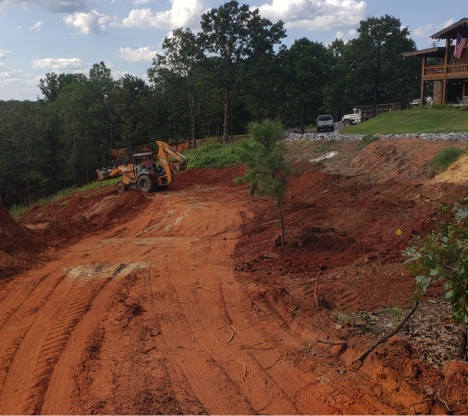
I decided I would use my old backhoe to help David and Ray move more dirt to the large depressed area they were filling. After hauling and depositing two loads of dirt at the dumpsite, I began moving the piled dirt at the end of the construction roadway where Ray had been dumping his truck loads. More of the piled dirt needed to be placed on the upper embankment, so I began moving the dirt from the flat landing area at the end of the construction road to the uphill side. I moved a couple of buckets of dirt to the upper hillside, including one load that I deposited on the upper hill about a front axle’s width from the little pine tree we were trying to save at Robin’s request.
I loaded the front bucket again with an extra full load and was traversing the side of the hill in a northerly direction. The grade of the hill itself immediately adjacent to the construction road is not steep enough to cause or worry about flipping, even when traversing it in a parallel direction which is the most dangerous. But three unfortunate, unplanned things occurred simultaneously to almost take my life.
My right front wheel started up a slightly high spot on the upper side of the hill—a high spot because of the prior bucket load of dirt that I had dumped there. At the very same time that my right front wheel began to move up the high spot, my left front wheel hit the wet spot next to the little pine tree. As previously reported, I had heavily watered the tree earlier and the ground around it was soaked. My left front tire, adjacent to the pine tree on the upper side, quickly sank at least a foot into the soft wet ground. Thirdly, my bucket was high up in the air because I was about to dump it.
Already on an incline, and with my right front tire raising a little higher, and with my left front tire simultaneously sinking lower, and with a fully loaded bucket high in the air, the center of gravity immediately shifted toward the downhill side. That triple combination caused the backhoe to tilt heavily to my left and commence to flip. I could definitely feel the exact precise moment when the weight of the tilting backhoe briefly hit equilibrium—perfectly balanced on two wheels, and then start into its rollover.
Perhaps quickly lowering the bucket could have prevented the impending rollover. I don’t know. I had no experience operating the machine in such an emergency situation. I did not know to attempt that maneuver at the first sign of trouble. In fact, I had never even studied or predetermined a course of action to take in the event of an impending rollover. I have generally altogether stayed away from driving the old machine on the side of inclines. (I think I may have already mentioned that fact.) I admit I am a scaredy-cat.
To significantly add to the danger, I was negligently not wearing my seatbelt, my standard procedure. I had never really considered the probability of my non-seatbelted body being crushed in a rollover by the metal canopy over my head. I plan to change my bad no-seatbelt habit.
The canopy is only six inches above my head when I am seated on the machine. Consequently if my head were to move outwardly only a very short distance during a roll over, my head, or neck, or chest would be crushed to the thickness of a pancake. Staying inside of the canopy area during a rollover is not likely to happen if the driver is not wearing a seatbelt.
I knew for a certain almost immediately, when the left tire sunk, that the machine was going to actually roll over. My very first fear and panic-driven inclination was to jump. The only direction I could have jumped was in the direction that the backhoe was tilting. I received a quick impression from the Holy Ghost to refrain from jumping. My decision not to jump was made in a split second. Perhaps past general discussions with David and others had placed in my mind an emphasis on the importance of not jumping.
At any rate, I know it was the Holy Ghost that created in me a quick, reactive instinct to grip the steering wheel as tightly as I could for as long as I could with both hands. So by clutching the steering wheel as tightly as I was able with two hands, I pulled or drew my entire body toward the steering wheel, even tucking my head and pulling my knees toward the steering wheel.
With my eyes tightly closed, I literally held on for dear life, as they say, as the steering wheel itself turned with the tilting. Using the steering wheel as an anchor to keep me inside of the caged area is what saved my life. Had I jumped, or had I merely slid out of, or fell away from, or been thrown from the inside of the caged area at any time prior to the completion of the rollover, the outer portion of the canopy, a heavy flat bar, would have fatally crushed me. Even as it was, with my gripping the steering wheel and trying to keep my body next to it, the flat bar barely missed the top of my head. All of this seemed to have happened in a flash. From the time of first tilting to the time that the canopy impacted the ground seemed to be almost instantaneous, although it must have taken two to three seconds I would imagine.
When the side of the upper canopy hit the ground, both of my hands were abruptly dislodged from the steering wheel, despite my best gripping power. The first part of my body to impact the hard-packed construction roadway was my left hip, which made walking difficult at first.
When the side of the upper canopy hit the ground, the toolbox on the backhoe flew open. It was located directly above me, and all of its contents were thrown toward me. There were tools and several heavy metal objects in the toolbox, and they all hit me on the head and upper forehead. It felt like a heavy rain downpour of metal objects. I commenced bleeding from the head wounds, causing blood to flow down my face and onto my shirt. I suppose it was the adrenalin that kept me from feeling any pain. Once I started walking away from the accident, the pain began to surface. But the injuries were quite minor. All of the blood made me look more injured than reality.
After the rollover, the backhoe motor was still running despite its being turned over on its side. I somehow remembered to turn off the motor, knowing it will pump oil into cavities where it should not go and ruin the engine. I had previously learned that from others who had been associated with rollovers. I believe I had the motor turned off within 15 seconds of the flip, notwithstanding I had to at least partially stand and find the switch in a disoriented condition. Being worried about a possible fire, I expeditiously moved away from the backhoe after turning off the switch.
Below is a photo of the backhoe on its side after the flip:
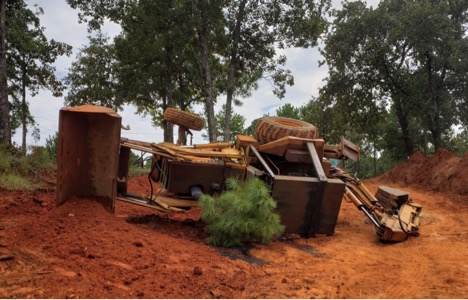
I am not going to try and save the little pine tree. I can find 100 more just like it to transplant if we really need one in that location.
Below is a photo of the rollover canopy area within which I needed to keep my body during the rollover, a process I had never before considered or mentally contemplated. I testify that the Holy Ghost substituted those negligently omitted personal contemplations and preparations with its own set of instantaneous instructions in my time of dire need.
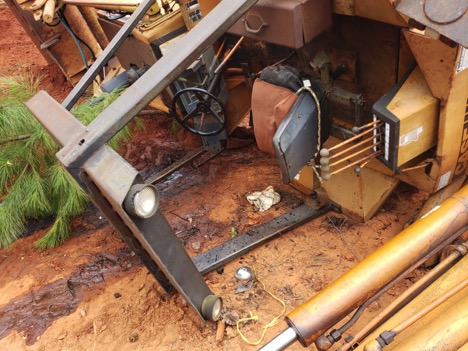
You can discern from the above photo how easily I could have fallen or been ejected outside of the canopied area during the rollover, and how the flat side of the upper bar would have crushed my body against the hard ground. The impact literally threw metal objects out of the rusty-brown toolbox which you can see at the top center of the photo.
No one saw me flip. Within seconds after the accident, a carpenter friend named Bryan working inside of the Overlook Lodge noticed from where he was working inside the lodge that the backhoe was laying on its side. That view gave him great concern since he could not see me anywhere. I soon emerged from the accident scene under the hill, walking up the hill toward him. I was stopping the head bleeding by pressing my undergarment shirt against the wounds.
Bryan headed for his first aid kit in his nearby parked pickup truck. Upon my reaching him, I declined the first aid because I wanted to wash off the cut places well before bandaging them, and I knew I could do a better job of that in my shower stall.
I walked the 300 feet to my home, stopping along the way to converse with David and Ray who were eating their sandwiches for lunch under the pecan tree next to my sawmill. They were sitting on some logs that we had hauled to the mill. They saw all of the blood on my head, face, and shirt. They listened to my quick and short explanation before I moved on to the house. I did not stay long enough to hear all of Ray’s personal rollover survival story.
I took a quick shower without bothering Robin, who was resting on the couch, any more than I had to. She herself is recovering from a concussion she received when she fell backwards on the tennis court four days earlier. After showering, I treated my own wounds with hydrogen peroxide, Neosporin, and one Band-Aid on the worse spot before going back outside to watch David and Ray raise the machine to an upright position.
My undergarment tee shirt was so soiled and bloody that Robin insisted I throw it away. So I did.
After some unsuccessful attempts using chains, David was able to use the front bucket of his backhoe to lift my machine to its all fours. David’s bucket lifted against the heavy roll bar canopy which did not give in the least. He and Ray moved my machine up the hill and parked it.
With a cap on my head, there was no outward sign that I had been involved in a rollover accident. I sent emails to our ten children telling them about the accident. I included photos.
I had lots of errands to run in town, so I went through with my earlier plan to make a trip to town.
I could easily have been dead, but there I was going through life normally and no one around me knew I had only shortly before been involved in what could easily have been a fatal accident. I had been spared by divine intervention, of which I am certain.
While in Winn Dixie, I ran into family friend Jane Franklin. She was the only person with whom I discussed my rollover accident, and I did so only because she inquired as to how I had been doing. I later emailed Jane some photos for her to show her husband, our local sheriff, who also drives machinery around his farm. I returned home from running my errands in town.
I am so grateful that God has some more living for me to do. I certainly need to make the best of it.